Choose a name to see its Greek text, its candidate plants and its 2,000-year record.
 pharmakon
Dioscorides described about 600 medicinal plants in the first century. Which plants did he actually mean — and did later science agree with him?
Research hypotheses only — not medical advice.
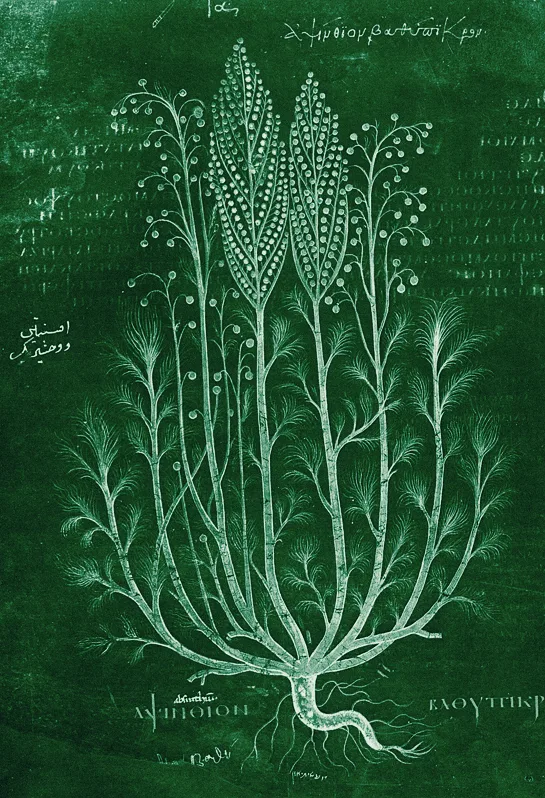
One word, more than one plant.
ἀψίνθιον· γνώριμος ἡ πόα.
“Wormwood: a well-known herb,” says Dioscorides — and moves on. Dictionaries give one answer. The evidence gives several. Pharmakon keeps all of them, each with a probability and an interval, and carries that doubt into every result downstream.
Open ἀψίνθιον in the explorerFrom a Greek sentence to a lab shortlist
Seven steps. Every number below is read from the pipeline's own reports.
Forty seconds through the whole record
A recording of this page: search a Greek name, read the passage, see the plant it most likely means, follow its uses for two thousand years, then test it against the future.
Ancient name explorer
Search any of the 653 drug names in Dioscorides by Greek (accents optional), transliteration, or modern species.
Two thousand years, one use at a time
Every use Dioscorides records, followed through Galen (2nd c.), John the Physician (13th c.) and modern Greek village medicine.
Is the survival real?
Among uses whose plant still appears in modern Greek records, how often does the same use survive — versus the same records with their uses shuffled?
What the evidence says
Two tests, reported the same way whether they worked or not.
Identification against experts
Agreement with the expert identifications of Lardos et al. (2024) for 61 Byzantine plant names, each name held out in turn. Bars show 95% bootstrap intervals.
The time machine
Stand in a past year, forget everything after it, and rank plant–condition pairs nobody had studied yet. Did history pick the ones science studied next?
Leads for the lab
Plant–condition pairs with no published pharmacology yet, ranked by forecast score × how sure we are of the plant. Hypotheses to test, never advice to use.
Use it from your own tools
The same data behind this page is open to AI assistants, scripts and notebooks. Everything is read-only and every reply carries the research-only notice and toxicity flags.
Ask an AI assistant
Connect the Pharmakon MCP server to Claude, Cursor or any MCP client, then ask things like “which ancient plants were used for burns?”.
claude mcp add --transport http pharmakon https://pharmakon.adoranto737.workers.dev/mcpTools: search_ancient_names, get_ancient_name, list_leads, get_lead, list_conditions, get_results.
Call the JSON API
Plain HTTPS, no key, CORS open.
curl "https://pharmakon.adoranto737.workers.dev/api/leads?condition=burn&limit=5"- /api/names?q= and /api/names/{id}
- /api/leads and /api/leads/{rank}
- /api/conditions and /api/results?section=
Run the pipeline
Every number on this page is rebuilt from open sources by one command. The research dashboard runs offline on the committed tables.
git clone https://github.com/LSUDOKO/Pharmakon
cd Pharmakon && make setup test app
Open data, checked at the source
Each source was queried live and its licence recorded. Every claim keeps the exact Greek words it came from.
Read before you cite
- The gold standard is expert judgement, not ground truth.
- “Support” means PubMed co-mention; the human label audit is still pending.
- Language models helped read the Greek and plant descriptions. Every quote they produced is checked word-for-word against the source, and none of it feeds the time-travel test.
- Paul of Aegina is not yet included. All body systems are covered; the Mount Pelion study only records skin uses.